

Law Firms
9 Accounting KPIs Every Law Firm Should Track
April 2026
If you run a law firm or consulting practice, you already know this: revenue alone doesn't tell the full story.
You can be busy, billing hours, and still feel like cash is tight. Or your firm might be growing, but you're not sure if it's becoming more profitable.
That's where the right KPIs come in. The firms that grow with confidence are the ones that consistently track a small set of meaningful numbers. Not everything. Just the right things.
Let's walk through the key accounting and finance KPIs that matter most and how they can help you make smarter decisions.
Why KPIs Matter for Law Firms
Professional service firms operate differently from most businesses. You're selling time, expertise, and relationships. That means your profitability depends on how efficiently you manage people, billing, and cash flow.
Tracking the right KPIs helps you:
- Spot issues before they become problems.
- Improve profitability without necessarily increasing workload.
- Make better hiring and pricing decisions.
- Reduce stress around cash flow.
Think of KPIs as both your early warning system and your growth roadmap.
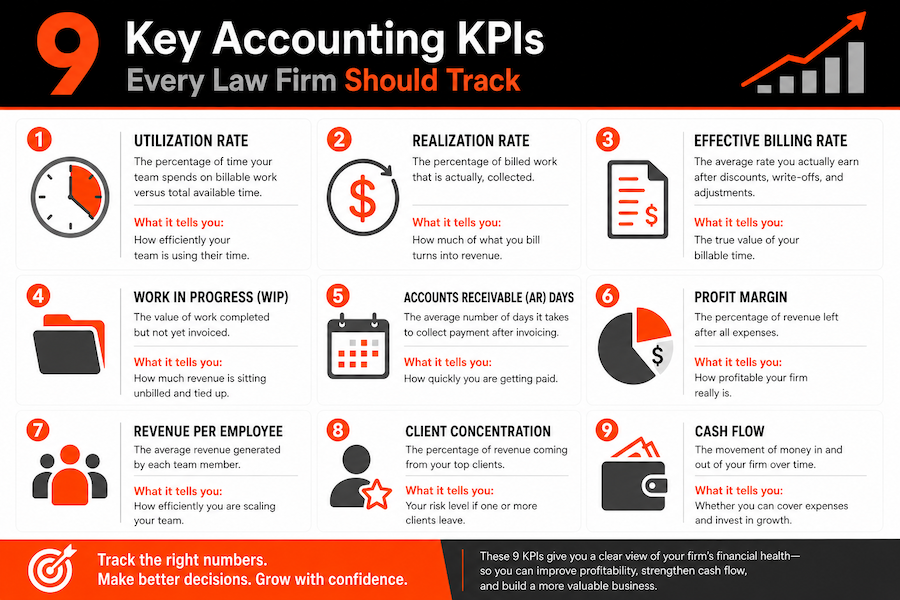
1. Utilization Rate: Are Your People Spending Time on Billable Work?
What it is: The percentage of time your team spends on billable work versus non-billable tasks.
Why it matters: If your attorneys or consultants are spending too much time on admin work, internal meetings, or business development, your revenue potential drops quickly.
Simple formula: Billable Hours ÷ Total Available Hours.
What to watch for: Low utilization may mean inefficiencies or overstaffing; very high utilization can lead to burnout. Strong firms strike a balance — protecting billable time while allowing room for client development.
2. Realization Rate: Are You Collecting What You Earn?
What it is: The percentage of billed work that actually gets paid.
Why it matters: You might be billing $500,000, but if you're only collecting $400,000, that gap matters.
Simple formula: Collected Revenue ÷ Billed Revenue.
What to watch for: Frequent write-downs or discounts, client pushback on invoices, and scope creep. Strong firms set clear expectations upfront, manage scope tightly, and review realization regularly — not just at year-end.
3. Effective Billing Rate: What Are You Actually Earning Per Hour?
What it is: The average rate you earn after discounts, write-offs, and adjustments.
Why it matters: Your standard hourly rate might look strong on paper, but your effective rate shows reality.
Simple formula: Total Revenue ÷ Total Billable Hours.
What to watch for: A gap between standard and effective rates, or underpricing and inconsistent billing. Strong firms use this KPI to guide pricing and adjust rates with confidence.
4. Work in Progress (WIP): How Much Revenue Is Sitting Unbilled?
What it is: The value of work completed but not yet invoiced.
Why it matters: WIP ties up cash. If you wait too long to bill, you delay getting paid.
What to watch for: Growing WIP balances, delays in invoicing, and inconsistent billing cycles. Strong firms bill regularly and keep WIP moving, improving cash flow without increasing workload.
5. Accounts Receivable (AR) Days: How Fast Are You Getting Paid?
What it is: The average number of days it takes to collect payment after invoicing.
Why it matters: Even profitable firms can struggle if cash is slow to come in.
Simple formula: (Accounts Receivable ÷ Total Revenue) × Number of Days.
What to watch for: Increasing collection times and clients consistently paying late. Strong firms follow up consistently and set clear payment expectations from the start.
6. Profit Margin: Is Your Firm Actually Profitable?
What it is: The percentage of revenue left after expenses.
Why it matters: Revenue growth without profit doesn't build a sustainable firm.
Simple formula: (Net Profit ÷ Revenue) × 100.
What to watch for: Rising expenses without corresponding revenue growth, or profit shrinking as the firm grows. Strong firms monitor profit regularly and adjust before small issues become big ones.
7. Revenue Per Employee: Are You Scaling Efficiently?
What it is: How much revenue each team member generates on average.
Why it matters: This helps you understand whether your team structure is efficient.
Simple formula: Total Revenue ÷ Number of Employees.
What to watch for: Declining revenue per employee as you hire, or roles that don't support revenue. Strong firms hire strategically and ensure each role contributes to growth.
8. Client Concentration: Are You Too Reliant on a Few Clients?
What it is: The percentage of revenue coming from your top clients.
Why it matters: If one client leaves and takes a large portion of your revenue with them, that's a risk.
What to watch for: One or two clients making up a large share of revenue, and a lack of diversification. Strong firms build a balanced client base to reduce risk and create stability.
9. Cash Flow: Can You Cover What's Coming Next?
What it is: The movement of money in and out of your firm.
Why it matters: Cash flow keeps your firm running day to day.
What to watch for: Timing gaps between billing and collections, large upcoming expenses, and seasonal revenue fluctuations. Strong firms forecast cash flow, not just review it after the fact.
Bringing It All Together
Here's the part most firms miss. Tracking these KPIs individually is helpful. But the real value comes from looking at them together. For example:
- Low utilization combined with strong demand might indicate staffing issues.
- High revenue and weak cash flow might indicate billing delays.
- Strong billing but weak realization might point to pricing or client issues.
These numbers tell a story. When you understand the story, you can make better decisions.
Where Most Firms Get Stuck
Many law firms and consulting firms know these KPIs exist. But they don't track them consistently because data lives in too many places, reports are hard to pull, and there's no clear process for reviewing them.
That's where having the right accounting and advisory support makes a difference. You don't need dozens of metrics to run a successful firm. You need the right few, tracked consistently, with a clear understanding of what they mean for your business. Once you have that, growth becomes more predictable and a lot less stressful.
Let's Start That Conversation
If you're not currently tracking these KPIs, or you're unsure what your numbers are telling you, it might be time for a closer look. A quick review of your firm's financials can often uncover opportunities to improve cash flow, increase profitability, and reduce risk.